Alex Jackson · October 21, 2026
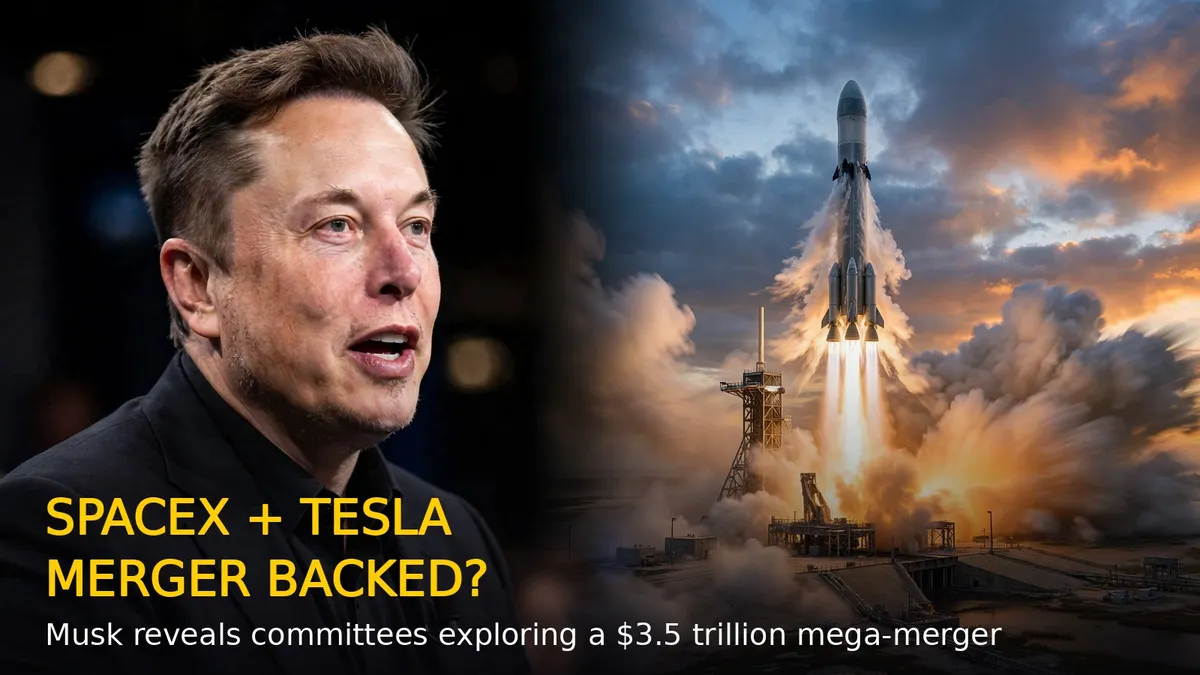
Elon Musk has thrown his weight behind what could become the largest corporate merger in history. Speaking on SpaceX’s quarterly earnings call on Tuesday, Musk confirmed that SpaceX and Tesla have formed special committees of independent directors to formally explore a potential merger between his two biggest companies.
The announcement sent SpaceX shares surging nearly 5 percent in after-hours trading, as investors digested the prospect of a combined corporate colossus worth more than $3 trillion.
What Musk Actually Said
Asked about a possible tie-up on the call, Musk said he felt he was “tap dancing through a minefield” discussing it, but that a combination would be “a good idea” with “a lot of merit,” given the companies’ complementary work on artificial intelligence.
He was careful to cool expectations. “Some people out there assume that a SpaceX and Tesla merger is a certainty, and I think that would be overstating it,” Musk said. “Do I think it would be a good idea? Yes. But at the end of the day, the shareholders have to be supportive of this.”
Musk also disclosed that he has recused himself from the committees’ deliberations due to a conflict of interest, as he serves as chief executive of both companies as well as chairman and chief technology officer of SpaceX. The committees were set up at the request of shareholders and have not yet agreed on the terms of any deal.
How Big Would the Combined Company Be?
The numbers are staggering. SpaceX is currently valued at around $2 trillion following its public listing, while Tesla is worth nearly $1.5 trillion. A merger would unite the world’s largest commercial rocket launcher and satellite internet operator with the world’s second-largest electric car maker under a single roof.
Musk himself is the connective tissue. He owns about 48.4 percent of SpaceX and controls more than 82 percent of its voting power through super-voting shares, while holding roughly 20 percent of Tesla.
Why Musk Wants It: AI, Chips and Robots
The driving logic, according to Musk, is superintelligence. He argued that an integrated structure would accelerate shared development in AI software, in-house chip architecture, robotics, and even space-based computing infrastructure.
The two companies already share deep business ties. SpaceX has purchased more than $100 million worth of Tesla Cybertrucks, and Musk’s AI venture xAI is a major customer of Tesla’s utility-scale batteries.
On the same call, Musk revealed that Terafab, the chip-manufacturing joint venture between SpaceX and Tesla, is targeting volume production of AI chips by the third quarter of 2028. Internally, the venture aims to have its first test chip, using SRAM circuits, functional by May or June of next year at its Austin research facility.
SpaceX’s AI Boom Fuels the Story
The merger talk landed alongside a blockbuster earnings report. SpaceX posted its first quarterly profit since going public in June 2026: net income of $4.4 billion for the July-September period, a sharp reversal from a $1.1 billion loss a year earlier. Revenue jumped 161 percent to $14.6 billion.
The turnaround was powered by the company’s AI division, now branded “Super Intelligence.” Revenue from the unit surged more than ninefold to $7.6 billion, overtaking Starlink as SpaceX’s biggest revenue driver, thanks to new cloud computing deals, the acquisition of AI coding startup Cursor, and growing adoption of the Grok chatbot.
The Hurdles Ahead
Musk was blunt about the obstacles. Any deal would need the approval of a majority of all outstanding Tesla shares, not just those cast in a vote, which he called “quite a high hurdle.”
A tie-up of this scale would also attract intense regulatory scrutiny around the world. And Musk has form when it comes to ambitious timelines slipping: he himself cautioned that the Terafab chip-production dates are “very aggressive” and carry “big error bars.”
Still, he has combined his companies before. Earlier this year he folded his AI startup xAI into the bigger SpaceX, and Tesla purchased the solar company SolarCity, where Musk was the largest shareholder, back in 2016.
What Happens Next
Tesla reports its third-quarter results on Wednesday, when Musk could face more questions about the plan. For now, the committees’ work is just beginning, and there is no guarantee they will reach an agreement.
But if they do, the deal would reshape not just two companies, but the future of AI, spaceflight and electric mobility in a single stroke. Watch this space.
RELATED STORIES