Alex Jackson · October 21, 2026
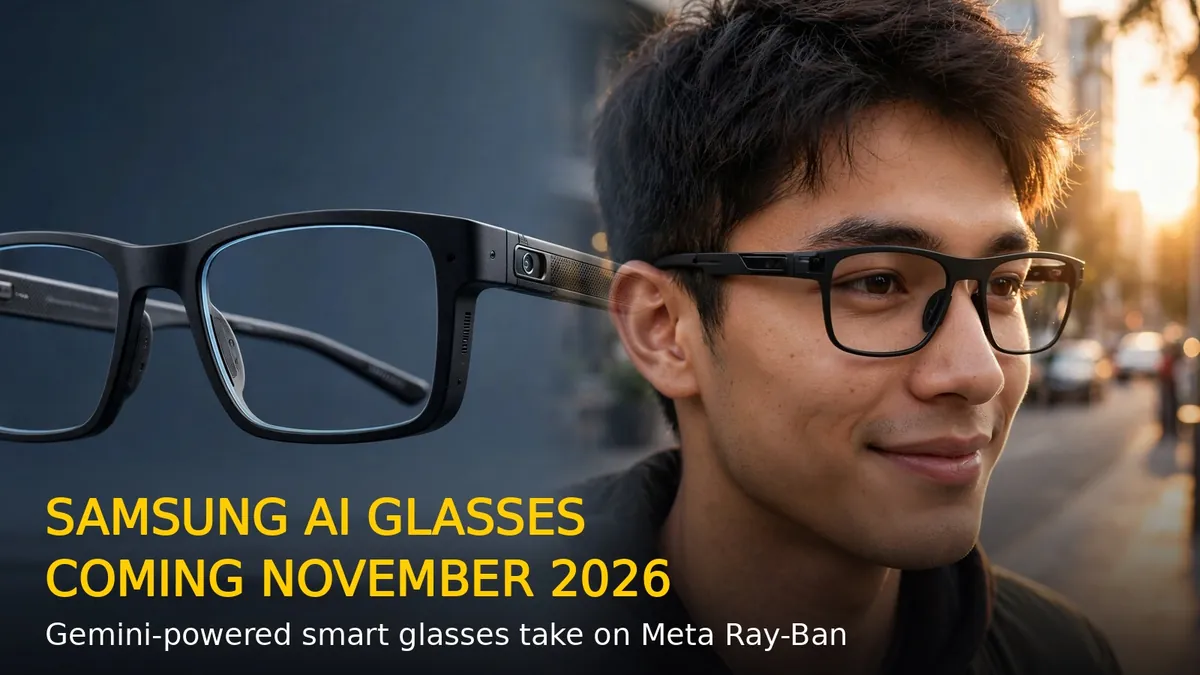
Samsung is about to enter one of the hottest tech categories of 2026. According to fresh reports, the company’s first AI-powered smart glasses are set to launch as early as November 2026, powered by Google’s Gemini AI. A Samsung executive has reportedly confirmed the November schedule, positioning the device as a direct rival to Meta’s Ray-Ban smart glasses.
Unlike a bulky AR headset, Samsung’s glasses are designed to look and feel like ordinary eyewear — with cameras, microphones, speakers and Gemini AI built in. Here’s everything we know so far about the launch date, specs, features and expected price.
Samsung AI Glasses Launch Date
Reports suggest Samsung’s first AI glasses will arrive in November 2026, though the company has not announced an exact launch date yet. Samsung and Google officially presented the glasses concept earlier this year, and development has been moving under the Android XR ecosystem.
The reported November window is for select global markets first. Samsung has not confirmed Indian availability or pricing so far, so buyers in India may have to wait for a later announcement.
Design and Specs: Built Like Real Glasses
Samsung is deliberately not treating this as just another tech product. The company worked with eyewear brands Gentle Monster and Warby Parker for design direction, so the glasses look like fashionable frames rather than futuristic hardware.
No Display, Focus on AI
Unlike Samsung’s Galaxy XR headset, these first-generation glasses do not have a display in front of the wearer’s eyes. Instead, they concentrate on cameras, microphones, speakers and hands-free AI assistance from Google Gemini. You talk to the glasses, and they see and hear the world around you.
Made for the Galaxy Ecosystem
The glasses are designed as a companion device and rely on a connected smartphone for heavier AI processing. Deep integration with Samsung’s Galaxy ecosystem means they should work best alongside Galaxy phones, much like the Galaxy Watch pairs with Samsung devices.
What Gemini AI Can Do on Your Face
With Gemini powering the experience, the glasses can answer questions about what you are looking at, translate live conversations, take photos and videos hands-free, play music and podcasts, and handle calls — all without pulling out your phone. Think of it as Gemini Live, but worn on your face all day.
Samsung AI Glasses vs Meta Ray-Ban: The Big Fight
Meta is currently the company to beat in AI glasses. Its Ray-Ban Meta Gen 3 starts at $449 with a 12MP camera and 3K video, while the camera-free Ray-Ban Meta Audio model starts at $349. Samsung is entering with the same philosophy — make the hardware look like normal glasses and let AI provide the intelligence — but with Gemini instead of Meta AI.
Samsung’s biggest advantage could be the Galaxy ecosystem: hundreds of millions of Galaxy phone users who might prefer Gemini-powered glasses over Meta’s offering. The battle for your face is officially on.
Expected Price and India Launch
Samsung has not announced pricing yet. Given that Meta’s AI glasses start at $349, Samsung will likely price its first-generation model in a similar range to stay competitive. Indian pricing and availability remain unconfirmed, and the reported November launch covers select global markets only.
Should You Wait for Samsung’s AI Glasses?
If you are already invested in Samsung’s Galaxy ecosystem and use Gemini daily, waiting for November makes sense — the integration could be the smoothest AI glasses experience on Android. If you need AI glasses right now, Meta’s Ray-Ban lineup is the proven option. Either way, 2026 is shaping up as the year AI moved from your phone to your face.
FAQs
When will Samsung AI glasses launch?
Samsung’s first AI glasses are reportedly scheduled for November 2026, though an exact date has not been announced.
Do Samsung AI glasses have a display?
No. The first-generation model has no display and focuses on cameras, speakers, microphones and Gemini AI assistance.
Will Samsung AI glasses launch in India?
Samsung has not confirmed Indian availability or pricing yet. The reported November launch is for select global markets.
RELATED STORIES