Alex Jackson · October 17, 2026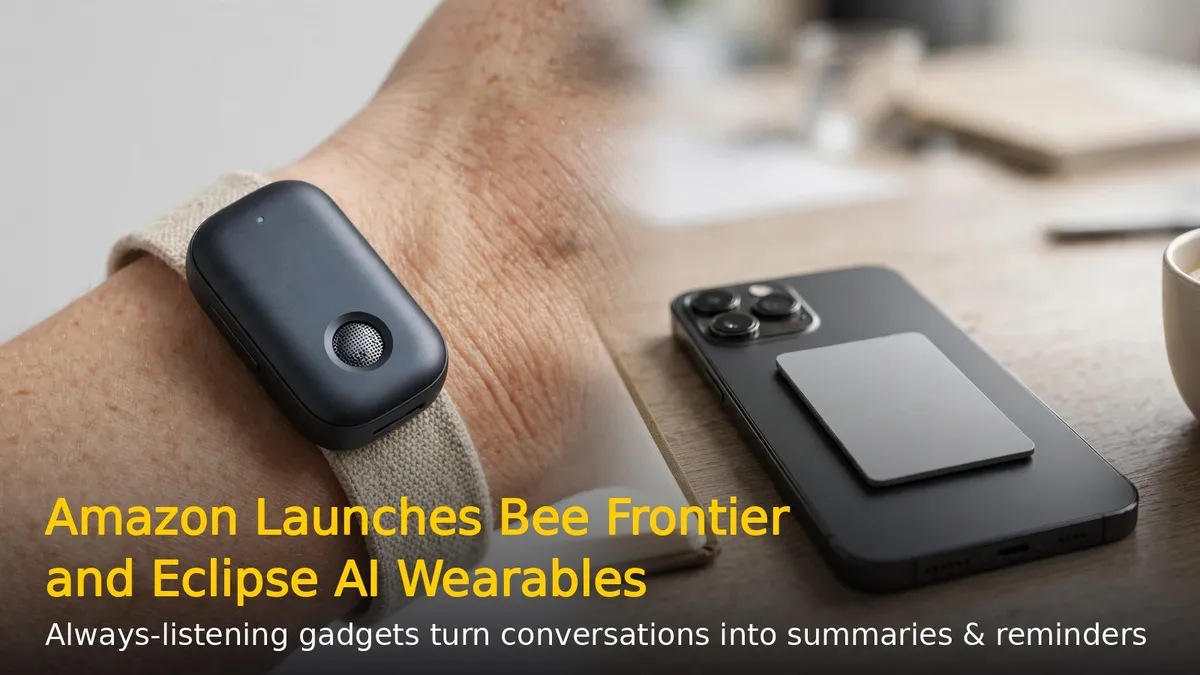
Amazon has unveiled two new AI wearables under its Bee brand — the Bee Frontier and the Bee Eclipse — announced on October 15, 2026. These are the first new Bee devices since Amazon acquired the startup in 2025, and they take a bold approach: they listen to your daily conversations and turn them into summaries, reminders, and to-dos automatically.
Bee Frontier: The Wrist or Clip Option
The Bee Frontier costs $74.99 and is on sale now. It is a small module you can wear on your wrist like a fitness band or clip to your shirt or bag. It is smaller and lighter than the original $50 Pioneer wristband, which has now been discontinued, and it comes in three colors: Onyx, Lavender, and Sage.
The biggest hardware upgrade is an IP67 rating for dust and water, something the old model lacked. It keeps the same seven-day battery life, USB-C charging, and dual microphones with noise filtering. A single press of its button starts a session, while a press-and-hold lets you ask the built-in assistant a question.
Bee Eclipse: A Magnetic Puck for Your Phone
The Bee Eclipse is a brand-new form factor for the company. It is a card-shaped device that snaps magnetically onto the back of your smartphone, and it packs three microphones. It is aimed more at professional settings like meetings and calls.
Because it is bigger, the Eclipse can hold a larger battery that Bee says lasts more than 21 days. It will cost $99.99 and come in Silver, Midnight, Honey, and Blush. Amazon says it is coming soon but has not shared a firm launch date yet.
What the Bee Pro Subscription Adds
Both devices work without a subscription. The free tier gives you conversation summaries, recaps, and 14 days of memory, and new buyers get 30 days of Bee Pro free. For $11.99 a month, Bee Pro unlocks unlimited conversation summaries, suggested to-dos, daily memories, a personal chat assistant, conversation templates, and third-party integrations — plus new links to Amazon.com and Alexa+ and a desktop app for Mac and Windows.
Bee already connects with tools like Gmail, Google Calendar, Outlook, and Apple HealthKit, so it can draft emails or send calendar invites based on plans you made out loud. The headline Pro feature is the Amazon tie-in: if you opt in, Bee can spot items you mentioned in conversation and suggest them on your Amazon homepage or in the Bee app.
The Alexa+ link lets you ask an Echo speaker for your Bee summaries or to-dos, with voice identification confirming it is really you before anything is shared. Both integrations stay off until you turn them on.
How Amazon Says Bee Handles Your Privacy
An always-listening gadget raises obvious privacy questions, and Amazon is leaning on a system it calls Private Compute. The company says raw audio is processed in real time and then deleted, so no recordings are stored. Transcripts are encrypted with keys created and controlled by your device — which, Amazon says, means even its own staff cannot read them.
Bee learns your voice during setup, and other speakers are not identified unless they agree. Each device has a light that turns on while it is summarizing, and users are prompted to get permission from call participants.
Should You Buy One?
If you have been curious about AI note-taking hardware, Bee is now one of the cheapest ways to try it — the Frontier undercuts rivals like the $159 Plaud Note and the $129 Pocket. Just keep a few things in mind: budget for the plan, since the best features need the $11.99 monthly subscription; tell the people around you when it is on; and keep the shopping link off until you fully trust it. Real-world accuracy and noise filtering still need independent testing, so waiting for early reviews is the smart move.
RELATED STORIES